Painting a Winter Landscape in Acrylics: Night Sky, Moon and Snow
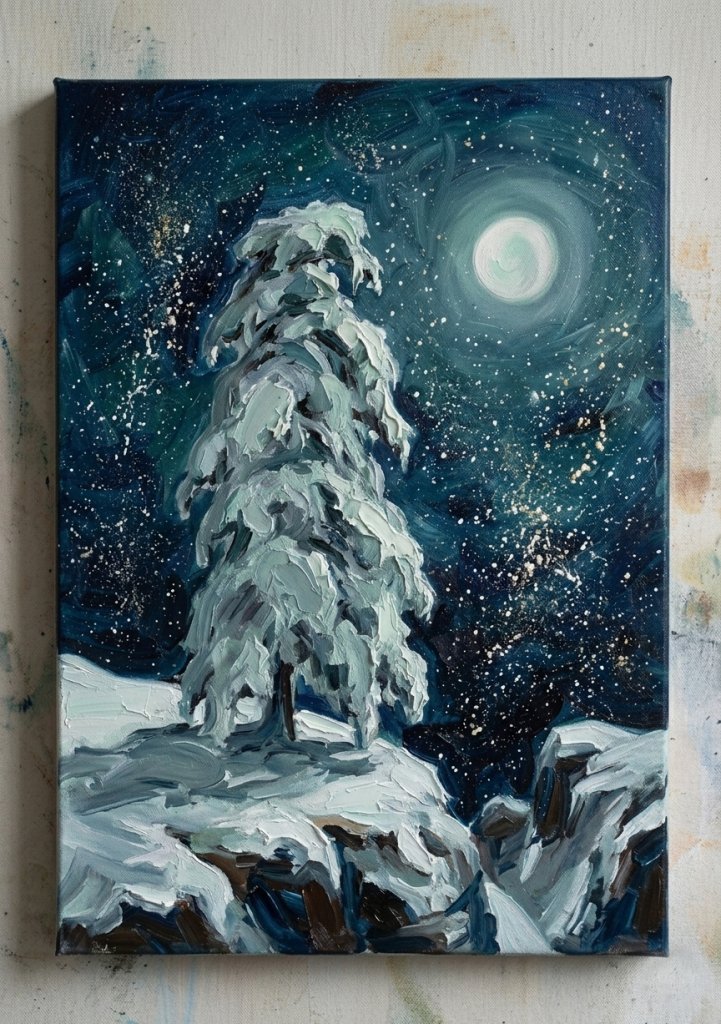
The best way to paint a winter landscape in acrylics is to work from dark to light: first lay in a deep night sky in blue, anthracite and turquoise, then add the moonlight, and finally the snow as the brightest areas. That is how light in the darkness is created – and it is exactly what gives a winter painting its atmosphere.
In this article I will show you step by step how to paint a night-time winter scene with a snow-covered tree under the moon. You don't need any previous experience, just a little patience while building up the layers.
Why acrylics work so well for a winter landscape
Acrylic paint dries quickly, which is a real advantage for a night scene: you can paint the dark sky and shortly afterwards add stars, moonlight and snow on top without the colours bleeding into each other. Thinned with water, acrylic becomes transparent and delicate; used straight from the tube, it covers strongly.
While the paint is still wet, you can also work wet-on-wet to create soft transitions in the sky – from an almost black top edge to the brighter glow around the moon. If you are not sure whether acrylic or oil suits you better, read my comparison Oil or acrylic for beginners.
Materials for your acrylic winter landscape
- Stretched canvas, for example about 40 × 50 cm
- Acrylic paints: titanium white, ultramarine blue, Prussian or phthalo blue, a turquoise, black or Payne's grey, a little yellow ochre
- Brushes: a wide flat brush for the sky, a medium round brush for branches, a fine brush for details
- an old toothbrush for stars and snowflakes
- palette, water jar, paper towels
Painting a winter landscape in acrylics: step by step
Step 1: The night sky
Mix three tones in advance: a very dark blue-anthracite, a medium blue and a light turquoise blue with some white.
- Paint the top edge with the darkest tone.
- Work the medium blue in further down while the paint is still wet.
- Place the light turquoise around the spot where the moon will be.
- Blend the transitions with a clean, slightly damp flat brush using criss-cross strokes.
If an area has already started to dry, let it dry completely and add a second thin layer on top.
Step 2: The moon and its glow
Paint the moon in almost pure titanium white with a touch of ochre – pure white often looks cold and flat. The real glow, however, happens in the sky around it: glaze a delicate halo of heavily thinned white around the moon. The darker the rest of the sky, the brighter this glow appears. Brightness comes from contrast.
Step 3: The snow-covered tree
Sketch the tree lightly with thinned dark paint. A tree grows upwards: the trunk is strong, and the branches get thinner and divide more finely towards the tips. Avoid symmetry – irregular shapes look more natural. Paint trunk and branches in a very dark blue-grey rather than pure black; at night, all colours are bluish.
Snow on the branches: Snow always sits on top of the branches. Dab thick white onto the upper sides with a small or dry bristle brush. On the side facing the moon the snow can be almost pure white; on the other side, mix in a little blue or turquoise. This gives the tree volume.
Step 4: Snowy ground, shadows and stars
The ground is never simply white. Use white with a little blue, and lighter areas where the moonlight falls. The tree casts a cool, medium-blue shadow on the snow, pointing away from the moon. Finally, flick fine white spatters onto the sky with a toothbrush for the stars, covering the moon with a piece of paper.
Frequently asked questions
Can I paint an acrylic winter landscape without experience?
Yes. A night scene with a tree and a moon consists of a few large shapes and is well suited for beginners. The key is the right order: from dark to light.
How long does such a painting take?
Including drying breaks, you can finish a painting of this size in an afternoon.
Which blues are best for a night sky?
Ultramarine is warm and soft, Prussian or phthalo blue cooler and more intense. A combination of both, plus anthracite and turquoise, gives a lively sky.
Conclusion: painting light in the dark
Painting a winter landscape in acrylics is a lovely exercise in contrast: a deep sky makes the moon shine, and carefully placed snow gives the tree its form.
Would you rather paint this motif together with me? In the course “Stille Nacht” in Düsseldorf we paint exactly this kind of snow-covered tree under the moon – all materials are provided and no experience is needed. More dates are on the painting courses page.
Gallery